💰 The 3 Money Models Every Chiropractor Should Know (And How to Pick the Right One)
Discover how the right money model can unlock higher cash flow, reduce churn, and make your practice way more scalable.
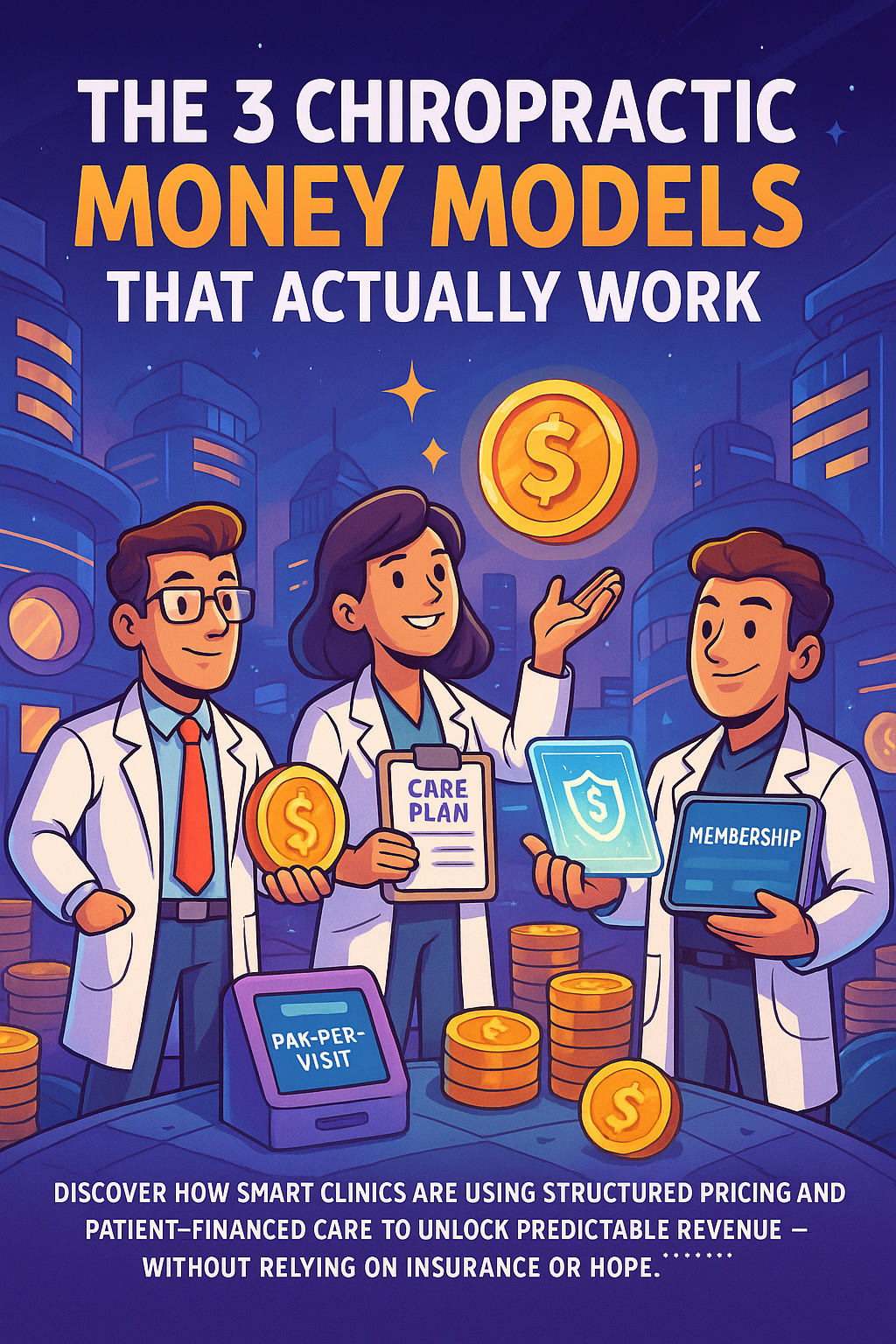
💰 The 3 Chiropractic Money Models That Actually Work
Discover how smart clinics are using structured pricing and patient-financed care to unlock predictable revenue — without relying on insurance or hope.
The Problem: Most Chiropractors Don’t Have a Money Model — They Have a Hope Model
If you’re like most chiros, your “money model” probably looks like this:
Adjust. Bill insurance. Repeat.
Or worse…
Offer a discount. Hope they stay. Repeat.
You’re not alone — most chiropractors never actually design their financial model.
But the truth is:
👉 The way you collect money determines how much you keep.
Today, I’ll show you the 3 proven money models successful practices use — and how to choose one that works best for your goals, your style, and your patient base.
🧠 Model 1: Pay-Per-Visit (The Old School Way)
Overview
This is the default for most chiropractors — especially insurance-heavy practices.
Patient comes in, pays per adjustment (or you bill insurance), and you start from scratch at every visit.
Pros
- Simple to explain
- Low barrier to entry
- Familiar to patients
Cons
- No cash flow predictability
- Encourages drop-off after pain relief
- You never know what’s coming next month
Verdict
If you’re early or insurance-based, this may still work.
But it’s the least scalable model — and one most 6-figure+ practices outgrow.
💎 Model 2: The Care Plan Model (Front-End + Back-End)
Overview
You package care into a structured, time-based plan (e.g., 12 weeks of care) with upfront or split payment options.
This is usually sold during a Day 1 or Day 2 consult.
You might include:
- Adjustments
- Rehab/exercises
- Lifestyle consults
- Home care materials
Pros
- Increases cash flow immediately
- Patients commit to full journey
- Less dropout = better results
Bonus Tip:
Use a $399 Challenge offer upfront to drive leads,
then upsell to a $2K–$5K care plan.
(We give you this full framework inside Spine Empire.)
Cons
- Requires patient education
- Needs a structured pitch (we give you one)
- More resistance than “just pay as you go”
Verdict
This is the highest-leverage money model for small chiropractic clinics.
Front-end offer funds your marketing.
Back-end plan drives profit.
Everyone wins.
🔁 Model 3: Continuity Membership
Overview
Patients enroll in a monthly care membership — usually after a 6–12 week care plan.
This becomes your long-term cashflow safety net.
Examples:
- $149/mo for 2 visits/month
- $199/mo includes massage or rehab
- $249/mo for priority booking & bonus perks
Pros
- Predictable revenue
- Creates “stickiness” and long-term loyalty
- Builds valuation if you ever want to sell
Cons
- Requires solid onboarding + retention
- Not great until you’ve proven your front-end
- Some patients resist ongoing payments
Verdict
Use this after you’ve installed a high-converting front-end and back-end system.
The membership model is your “moat” — it builds your business value over time.
So Which Model Should You Use?
Use all three — in this order:
- Front-End Offer (Challenge or Low-Ticket Seminar) → $399
- Back-End Care Plan → $2K–$5K
- Continuity Membership → $149–$249/month
This Patient-Financed Model is how smart chiros scale fast without outside capital.
📥 Want All the Templates, Scripts & SOPs?
We’ve packaged everything:
- ✅ Challenge offer templates
- ✅ 3-option price sheets
- ✅ Consultation scripts that convert
- ✅ Membership agreement docs
- ✅ 6-month retention SOPs
Ready to see whether the system fits your clinic?
If the article made the bottleneck feel clearer, use the strategy call to look at the offer, the rollout expectations, and whether the model makes sense in your market.