Chiropractic Care Plans Guide: $399 Starter → $4,500 Program
Knowledge, not templates: the principles behind plans patients accept-ethically, clearly, and without pressure.
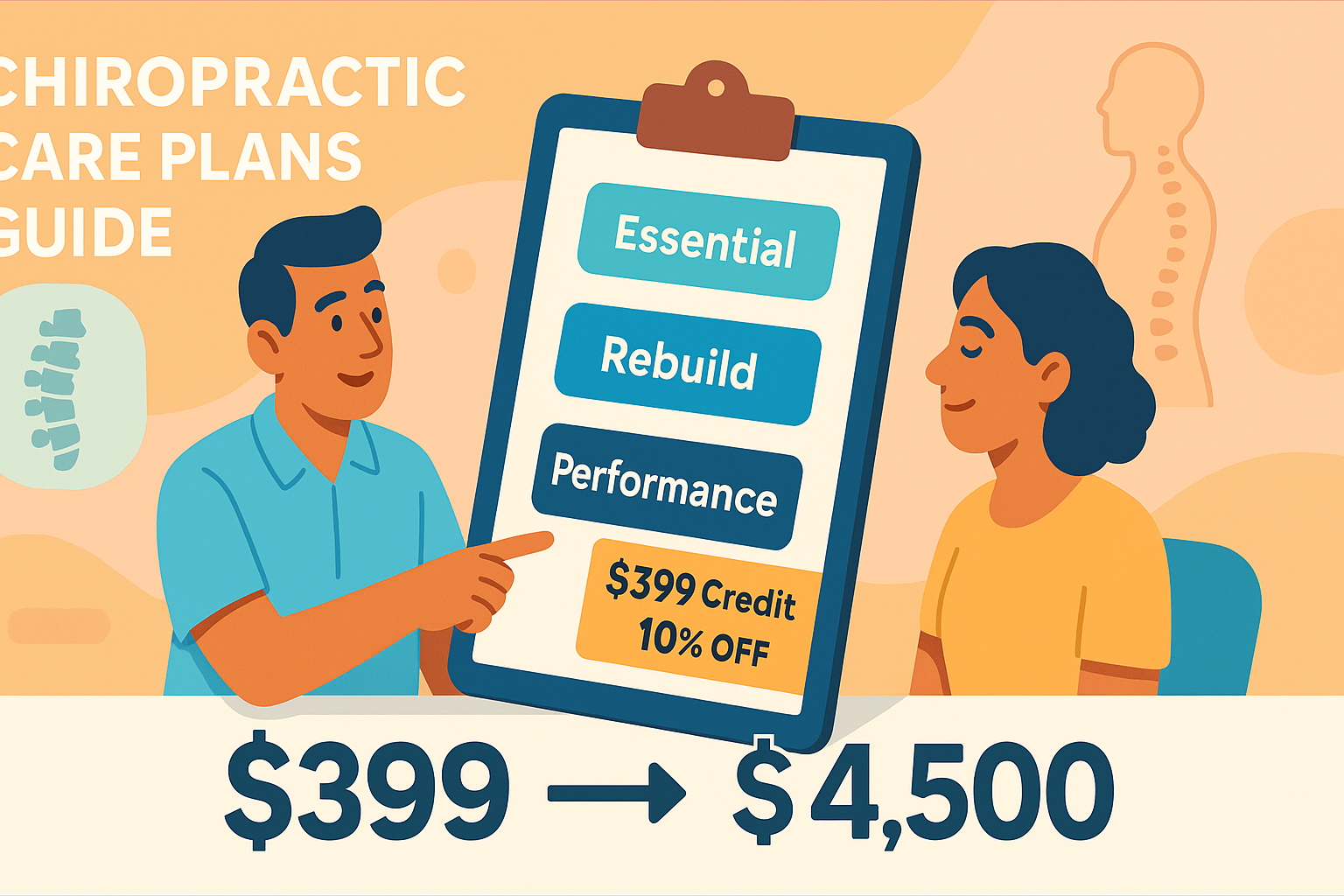
Goal: teach you the why and how behind care plans that patients accept-without scripts or templates. You’ll learn the decision science, the economics, the ethics, and the operating rhythm so you can build your own plan structure confidently.
New here? See how demand gets created (seminar → starter → plan): /how-it-works.
Need a quick diagnostic first? Scheduling → /analyzer • Cash Flow → /cash-flow-analyzer
Why Plans Beat Per-Visit Selling (and When They Don’t)
Per-visit care feels flexible but creates three problems:
- Unclear outcome - patients don’t know what “done” looks like.
- Payment fatigue - constant micro-decisions; drop-off rises.
- Operational noise - forecasting, scheduling, and collections get messy.
Care plans fix this when:
- The case requires multiple phases (relief → rebuild → performance).
- The outcome can be expressed in plain language and measured periodically.
- The patient values predictability over ad-hoc visits.
When a plan is not appropriate: acute one-off visits, red flags needing referral, or when uncertainty is too high to outline a phase responsibly.
The Outcome-First Model (before you think money)
Patients buy outcomes, not visits. Start here:
-
Define the functional goal in plain language
“Sit through a 60-minute meeting without numbness.” -
Choose the cadence window that plausibly achieves it
Relief (2–6 weeks), Rebuild (4–12 weeks), Performance (ongoing / taper). -
Set checkpoints tied to function, not feelings
Examples: sleep quality, sit/stand tolerance, lift tolerance, step count, ROM. -
Publish how progress is shown
One page with baseline → mid → end. Paper works; EHR snapshots work.
Why this matters: people continue when they see progress. A plan makes progress visible and scheduled.
Pricing: Principles That Prevent Backlash
This is not about tricks; it’s about clarity and fairness.
- Anchor to outcomes, not minutes. Price reflects the program that gets them to a goal, not just the time spent.
- Keep a clean round number. Round totals reduce friction (fewer “why $4,483?” moments).
- Create one “starter” step. A low-risk paid starter (exam/ROF/first treatment) lets adults test fit without committing to a plan.
- Credit that starter. If they continue, credit it into the plan to avoid sunk-cost feelings.
- Have one small incentive window. A time-bound courtesy while they’re in the starter rewards decisiveness without pressure.
- Be transparent about what could change. If imaging, specialist referral, or coverage decisions could alter cost, say so in advance.
Want to sanity-check numbers for your clinic? Use the Cash Flow Analyzer: /cash-flow-analyzer
Insurance Integration (hybrid clinics)
You can keep a plan frame and still apply benefits:
- Present two paths clearly:
A) Insurance-guided care - cadence limited by coverage; portions may vary.
B) Program care - predictable cadence and totals; insurance applied where appropriate.
Let adults choose the trade-off they care about: speed/predictability vs. maximizing coverage. Publish the differences; avoid surprises.
Ethics & Compliance (non-negotiables)
- No outcome guarantees. You can guarantee process (re-evals, touches, education), not results.
- Use plain-English consent. Cost, cadence, what’s included, and what may change.
- Respect discount rules. Understand state and payer rules for time-bound courtesies or family pricing.
- Keep PHI private. Progress snapshots are fine; never display identifying details without written consent.
Presentation: How to Explain Plans Without Feeling “Salesy”
You don’t need a script to be effective. Follow these principles:
- Teach first. Explain the condition in simple terms, what makes it better/worse, and what to expect in the next 4–6 weeks.
- Match the goal to the plan. “Based on your goal (e.g., sleep through the night), this cadence gives us the best shot.”
- Use paper. A printed one-pager reduces cognitive load and shows you’re prepared.
- One recommendation. Multiple choices increase anxiety; present one best fit and explain why.
- Pause. After presenting, be quiet. Let people think.
- Offer two time options. Decision friction is lowest when the next step is concrete.
This is adult-to-adult. No pressure; just clarity.
Measuring Success (so you don’t fool yourself)
Track these weekly (a whiteboard is enough):
- Starter → Plan acceptance (target 60–70%)
- Plan completion (target ≥80%)
- Show rate for plan visits (target ≥70%)
- Refund/adjustment rate (watch spikes)
- Reviews/month from plan completions (target 10–20)
If acceptance is low, your education or fit is off. If completion is low, your cadence or progress visibility is off. Fix one constraint at a time.
Handling Common Objections (without scripts)
-
“That’s expensive.”
Reframe value. “It’s more than per-visit, and it also removes uncertainty and sets us up to reach your goal by [date]. If we want to go slower and let coverage dictate cadence, we can-just know it’ll likely take longer.” -
“I want to think about it.”
Honor autonomy. “Of course. Would a side-by-side of the two paths help? I can text you a summary and hold two times in case you choose to start.” -
“What if it doesn’t work?”
Process guarantee. “We can’t promise outcomes, but we do promise the process-re-evals every few weeks, adjustments to the plan if you plateau, and clear reporting so you’re never guessing.” -
“Can we do fewer visits?”
Trade-off clarity. “We can reduce cadence and likely extend the timeline. If speed matters because of work/family demands, this cadence is our best shot.”
Case Pattern: How Plans Change Real Life (composite)
- Starting point: 42-year-old desk worker, radicular pain, sleep disrupted, can’t sit >20 minutes.
- Goal: sit through a 60-minute meeting and sleep through the night 5/7 days.
- Plan frame: Relief (4 weeks, frequent cadence), Rebuild (8 weeks, taper), Performance (optional).
- Checkpoints: sleep score, sit tolerance, straight-leg raise, walking minutes.
- Outcome: visible gains by Week 4; goal achieved by Week 10; chooses optional performance phase 1×/2 weeks.
Note: exactly how you deliver care is clinical judgment. The plan simply structures expectations and progress.
Operational Rhythm (so plans don’t crumble)
- Speed-to-lead <60s on new interest (seminar RSVPs, web inquiries).
- Book the first two plan visits before the patient leaves the consult.
- Re-evals on the calendar at plan start (not “we’ll see”).
- Reminders: T-24h/T-2h/T-30m to protect cadence.
- Two 72-hour priority holds per provider for rebooks and new starters.
- Scoreboard updated Mon/Thu so the team can see reality.
If your show rate or cadence is the bottleneck, fix scheduling first: /analyzer
Avoid These Pitfalls
- Pricing a plan like a bundle of adjustments. Price the program, not the components.
- Hiding uncertainty. If a variable could change cost or cadence, state it before enrollment.
- Too many options. One recommendation outperforms three similar choices.
- No visible progress. If a patient can’t see change, they won’t finish-even if they’re improving.
- Talking fast. Silence after the recommendation is part of the process.
Change Management: Rolling Plans Out in an Existing Clinic
Week 1: write your outcome language, choose checkpoints, and outline two care paths (insurance-guided vs. program).
Week 2: train the team on why plans exist and how progress gets shown; rehearse the consult flow.
Week 3: pilot with new patients only; collect feedback, refine clarity.
Week 4: extend to appropriate existing patients at natural re-eval points; publish a simple FAQ at the front desk.
The Demand Side (why your plan acceptance will rise)
Plan acceptance is easiest when people meet you in a trust-building setting:
- Host a free local seminar (education first).
- Invite the starter as a low-risk next step.
- Patients who resonate choose the plan that matches their goal and schedule.
See how that demand engine works: /how-it-works
Next Steps (build your version)
- Write your outcome statements (in patient words).
- Choose checkpoints and set re-eval intervals.
- Decide your starter (what’s included and why it exists).
- Set a clean plan price that reflects the program and your market.
- Train the team on education → recommendation → pause.
- Put a scoreboard up and improve one constraint at a time.
If you want a quick read on where your plan math or schedule cadence is breaking:
- Scheduling Efficiency Analyzer: /analyzer
- Clinic Cash Flow Analyzer: /cash-flow-analyzer
Teach first. Recommend once. Let adults decide. That’s how you build care plans patients understand-and finish.
Ready to see whether the system fits your clinic?
If the article made the bottleneck feel clearer, use the 20-minute strategy call to look at the offer, the rollout expectations, and whether the model makes sense in your market.